Survey: Less Than 1
Percent of Young Adults Hold Biblical Worldview
Less than one percent of the youngest
adult generation in America has a biblical worldview, found a new study
examining the changes in worldview among Christians and the overall U.S.
population.
The Mosaic generation, those between
the ages of 18 and 23, “rarely” have a biblical worldview as defined by
The Barna Group. The research data found that less than one-half of one
percent of Mosaics have a biblical worldview.
A biblical worldview, as defined by the
Barna study, is believing that absolute moral truth exists; the Bible is
completely accurate in all of the principles it teaches; Satan is
considered to be a real being or force, not merely symbolic; a person
cannot earn their way into Heaven by trying to be good or do good works;
Jesus Christ lived a sinless life on earth; and God is the all-knowing,
all-powerful creator of the world who still rules the universe today.
Only if someone held all the above
beliefs did the research consider the person as having a biblical
worldview.
George Barna, who directed the
research, commented on the “troubling” generational pattern that
suggests “parents are not focused on guiding their children to have a
biblical worldview.”
“One of the challenges for parents,
though, is that you cannot give what you do not have, and most parents
do not possess such a perspective on life,” he noted.
The research shows that only nine
percent of all American adults have a biblical worldview, which although
significantly higher than that of the Mosaic generation is still a small
proportion of the total population.
Among “born again Christians,” the
study found that they are twice as likely as the average adult to have a
biblical worldview. However, that still amounted to no more than about
one out of five (19 percent) born again Christians, a small minority,
the study pointed out.
A born again Christian is defined by
Barna as those who said they have made a personal commitment to Jesus
Christ that is important in their life today and that they are sure they
will go to Heaven after they die only because they confessed their sins
and accepted Christ as their savior.
Some of the problems American adults
and born again Christians have with the biblical worldview definition
include believing that moral truth is absolute and unaffected by the
circumstances.
Only one third of all adults (34
percent) hold this worldview, and while more born again adults believe
in absolute moral truth, still less than the majority possess this
outlook (46 percent).
Another belief that American adults
struggle with is the view that Satan is a real force. Only slightly more
than a quarter of adults (27 percent) believe Satan is real, and less
than half of born again adults (40 percent) have this worldview.
Also, 28 percent of all adults and 47
percent of born again Christians believe it is impossible for someone to
earn their way to Heaven through good behavior.
The general American public and the
born again population differ greatly when it comes to the belief that
Jesus Christ lived a sinless life while He was on earth. Forty percent
of adults hold this belief, while 62 percent of born again Christians
are convinced that Jesus was sinless.
George Barna commented, “There are a
several troubling patterns to take notice. First, although most
Americans consider themselves to be Christian and say they know the
content of the Bible, less than one out of ten Americans demonstrate
such knowledge through their action.”
He also
noted that the study raises questions on how effective of a job
Christian churches, schools and parachurch ministries are doing in
Christian education.
“Finally,
even though a central element of being a Christian is to embrace basic
biblical principles and incorporate them into one’s worldview, there
has been no change in the percentage of adults or even born again
adults in the past 13 years regarding the possession of a biblical
worldview,” said the founder of The Barna Group.
Compared to
previous similar Barna studies, the results for this year show that
the overall American worldview has remained largely unchanged for more
than a decade.
In 1995, for
instance, seven percent of American adults had a biblical worldview,
compared to the nine percent in 2008.
Even among
born again adults the statistic remained the same with 18 percent
having a biblical worldview in 1995, 22 percent in 2000, 21 percent in
2005, and 19 percent in 2008.
The report
is based on four nationwide telephone interviews conducted by The
Barna Group, each including between 1,002 to 1,005 adults randomly
selected, in the years 1995, 2000, 2005, and 2008. Interviews were
conducted among adults in the 28 continental states.
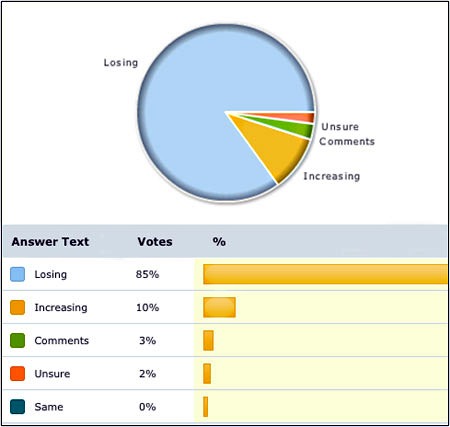
Do you think religion as a
whole is increasing its influence on American life or losing its
influence?
February 2009
From the Christian Examiner...............
.......................................................................................................................
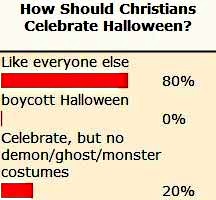 We
must say that we are disappointed that most people voted to celebrate a
day that is a culture of death like everyone else. We
must say that we are disappointed that most people voted to celebrate a
day that is a culture of death like everyone else.
St. Paul tells us to not even have the appearance of evil.
Christians ought to Christianize the holiday and make it our own rather
than violating Biblical teaching and common sense by participating in
revelry that depicts evil and horror.
From St. Michael's Call
(We rarely would use information from a Catholic Ministry but this Poll
in no way promotes Catholicism)
What Will it Take to Fix Christian Television?
Change the Way it's Funded (23%)
Better Spiritual Accountability
(15%)
Better Financial Accountability
(2%)
Better Training For Staff (3%)
More Professionalism (11%)
Christian TV Can't Be Fixed (9%)
Christian TV Doesn't Need Fixing
(0%)
The latest poll - "What Will
It Take To Fix Christian Television" is finished and the
results are very interesting. The #1 problem in your mind
seems to be a lack of creativity, closely followed by the
need to change the way it's funded. I would personally have
put the funding issue #1, because until we can change the
"paid-time" model of media buying - which forces the
programmer to raise money through product offers - we're
never going to raise enough $$ for serious movies,
documentaries, and special event programming.
Something else that caught my
eye was the 9% who believe that Christian TV can't be fixed.
It was also interesting that not one person felt that it
didn't need fixing. So everybody that voted felt like the
industry was lacking something - and amen to that.
I
would love to hear your comments about the poll. What do you
think? Any specific ideas for improvement?
from
Phil Cooke Ministries
OK the results are in... the biggest issue according to my
readers...
|
Homosexuality |
8.2% |
|
Greed |
1.4% |
|
Nationalism |
20.5% |
|
Loss of the Authority of Scripture |
35.6% |
|
Loss of emphasis on the Substitionary Atonement |
11.0% |
|
Lack of love and grace |
23.3% |
The only surprise for me was the % of votes on the issue of
Nationalism. While I would share this concern and polls outside the
US have shown this is a major concern of our brothers and sisters
around the world it seems to be a concern that is often ignored or
else seen as a good thing rather than a concern.
Perhaps 'lack of love and
grace' speaks to our tendency to speak from the 'bully pulpit' and
not take the time to build real relationships with people.
I did think that greed
might have been seen as a greater issue.
from
NeilCraigan.Com
The Polls listed below are from Previous
Forgotten Word Ministries Polls. |